


From AI Models to Intelligent Business Infrastructure: Growthware and Google's Gemini API CLI

By Justin Liles - Published November 05, 2026

Artificial intelligence is moving beyond conversational interfaces toward systems that interpret data, use specialized tools, and help coordinate business workflows. Google's Gemini API CLI is a useful technical building block for this shift.
For Growthware, the opportunity is not another chatbot. It is an architecture that can connect operational business information with Growth Index measurement, Growthbooks recommendations, and accountable execution. This article describes a proposed integration direction, not a confirmed production deployment.
The gemini-api command gives developers command-line access to Gemini model capabilities such as generation, structured output, multimodal file analysis, media workflows, and managed-agent interactions. It is useful for development experiments, scheduled analysis, and controlled agent environments. Google also offers direct APIs that may be more appropriate for latency-sensitive product workloads.
Growthware's native CRM, Inbox, Calendar, Payments, Listings, and Websites services produce operational signals. Growth Index normalizes those signals across visibility, trust, engagement, bookings, and revenue. Growthbooks converts measured constraints into playbooks and recommended next steps. An AI orchestration layer can help translate verified signals into useful explanations and candidate actions without replacing the scoring engine or service authorization rules.
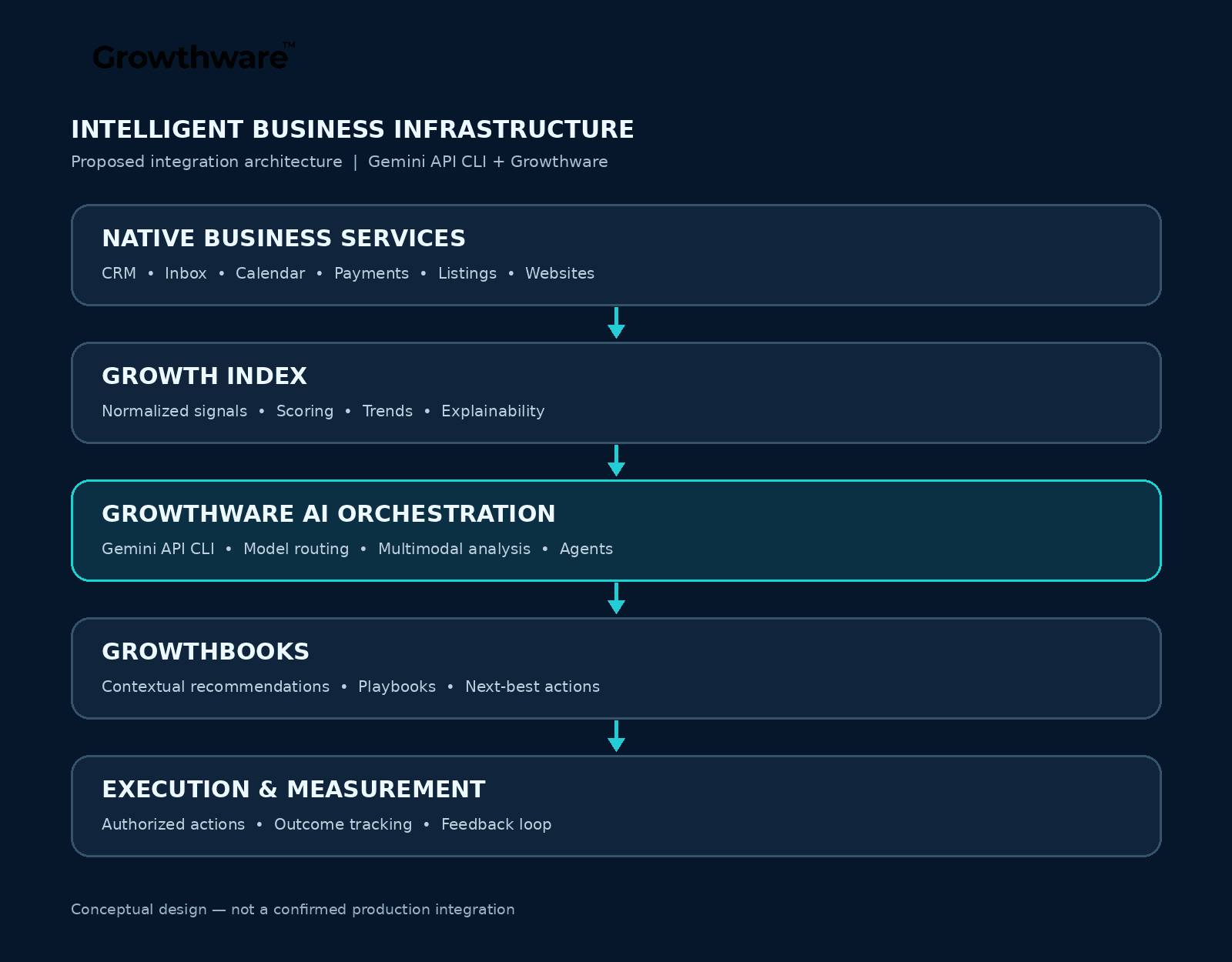
This architecture is conceptual. Growth Index remains the source of measured performance, while AI proposes interpretations and Growthbooks connects them to actionable workflows. Generated explanations must clearly separate observed facts from hypotheses.
When bookings fall and message response times rise, Growthware can pass a validated, scoped metric snapshot to a model. The model can propose a concise explanation and rank potential next steps. Growthbooks can then connect the recommendation to native Inbox or Calendar functionality, while Growth Index measures what subsequently changes.
Invoices, PDFs, photos, messages, and other documents contain information that is difficult to fit into a database. Multimodal processing can extract proposed structured fields for human review before they enter a merchant's records. Tenant isolation, minimal data disclosure, and schema validation are essential.
Growthware's Websites, Listings, and Creation capabilities can use approved business information to create draft copy and campaign concepts. Brand checks, factual validation, and publication permissions must remain part of the workflow.
An agent may identify an incomplete listing, another may suggest a correction, and Growthware can validate the proposed action. Agents should not bypass authorized service APIs, audit logs, or approval requirements.
Start with sanitized Growth Index snapshots. Execute a model-analysis workflow in an isolated environment. Require machine-readable recommendations, validate them against strict schemas, store the model configuration and source indicators, and route accepted suggestions through Growthbooks. The CLI is useful for prototyping and controlled batch work; direct Gemini APIs should also be evaluated for production customer-facing latency and reliability.
A recommended engineering test would ask the model to identify the three strongest constraints while separating measured facts from hypotheses. Validation must reject claims unsupported by the supplied metrics. Outcomes should be tracked as actual business events, not simply as completed AI tasks.
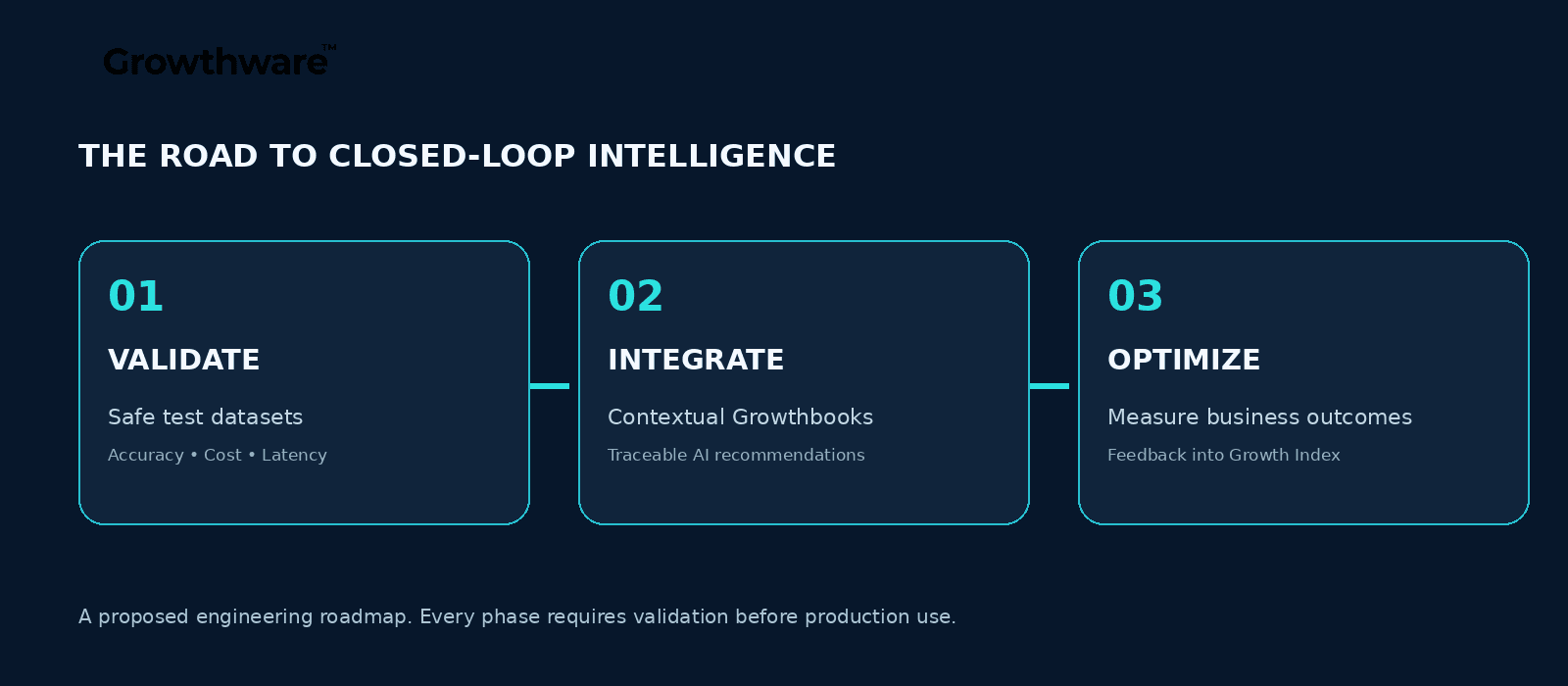
Phase 1, validation: benchmark structured output, accuracy, latency, costs, and repeatability using synthetic or approved sanitized test data. Phase 2, integration: connect validated insights to Growthbooks while preserving explainability, permissions, and human review. Phase 3, optimization: compare recommendations with real booking, payment, engagement, trust, and visibility outcomes.
The system must enforce tenant-level isolation, least-privilege credentials, validated output, observability, and explicit approval for consequential changes. Each recommendation should connect to its input metrics, execution trace, action status, and eventual measured outcome.
The value is not the model alone. It is the intelligence layer that connects trustworthy data, useful action, and measurable results. Growthware's opportunity is to make business software more intelligent, connected, and accountable to growth.
Technical sources: https://aistudio.google.com/learn/introducing-the-gemini-api-cli ; https://github.com/google-gemini/gemini-api-cli ; https://ai.google.dev/gemini-api/docs/interactions-overview
Editorial clarification: This article is a technical innovation proposal and does not represent a verified live Gemini API CLI integration in Growthware.

Article by
Justin Liles
Justin Liles builds, publishes, and writes about the systems, ideas, and stories shaping what comes next for Growthware. His work spans product strategy, AI, connected business intelligence, entrepreneurship, growth infrastructure, and the architecture behind Growthware’s evolving business operating system. He is the creator behind Growthware.ai’s innovation ecosystem, Growthware Daily, Hidden Gems, Builder’s Journal, original research, product experiments, and strategic frameworks exploring how technology, creativity, intelligence, and execution can work together to create meaningful growth.


