


What Is Growthware.com vs. Growthware.AI

By Justin Liles - Published November 02, 2026

GROWTHWARE ORIGINAL | STRATEGY & INNOVATION | NOVEMBER 2026
One brand. Two very different jobs.
Growthware.com shows what Growthware is ready to bring to market. Growthware.ai shows where Growthware is going next.
Most technology companies have one public website. It explains the product, highlights features, communicates value, and gives someone a reason to take the next step.
Growthware has that too. That is Growthware.com.
But Growthware is building more than a collection of software features. Behind the commercial platform is a much larger system of experiments, prototypes, intelligence layers, operating surfaces, architecture, and strategic bets.
That story needs a different kind of home. That is why Growthware.ai exists.
Growthware.ai is the public innovation and strategy layer behind the Growthware ecosystem. It is where we can show the ideas being tested, the systems being connected, and the architecture being developed before every piece becomes a mature commercial product.
The simplest way to think about it is this: Growthware.com sells. Growthware.ai explains.
Growthware.com exists to answer a practical question: What can Growthware do for my business?
Its job is to make the platform understandable and help businesses see how Growthware can help them get seen, get booked, get paid, build trust, operate more effectively, and understand what is driving growth.
Growthware.com is where the commercial story gets sharp. It is where buyers should understand the platform promise, the value of connected business tools, and why Growthware is different from a pile of disconnected software.
The goal is clarity. The goal is confidence. And ultimately, the goal is helping someone decide whether Growthware belongs inside their business.
Growthware.ai answers a completely different question: What is Growthware becoming?
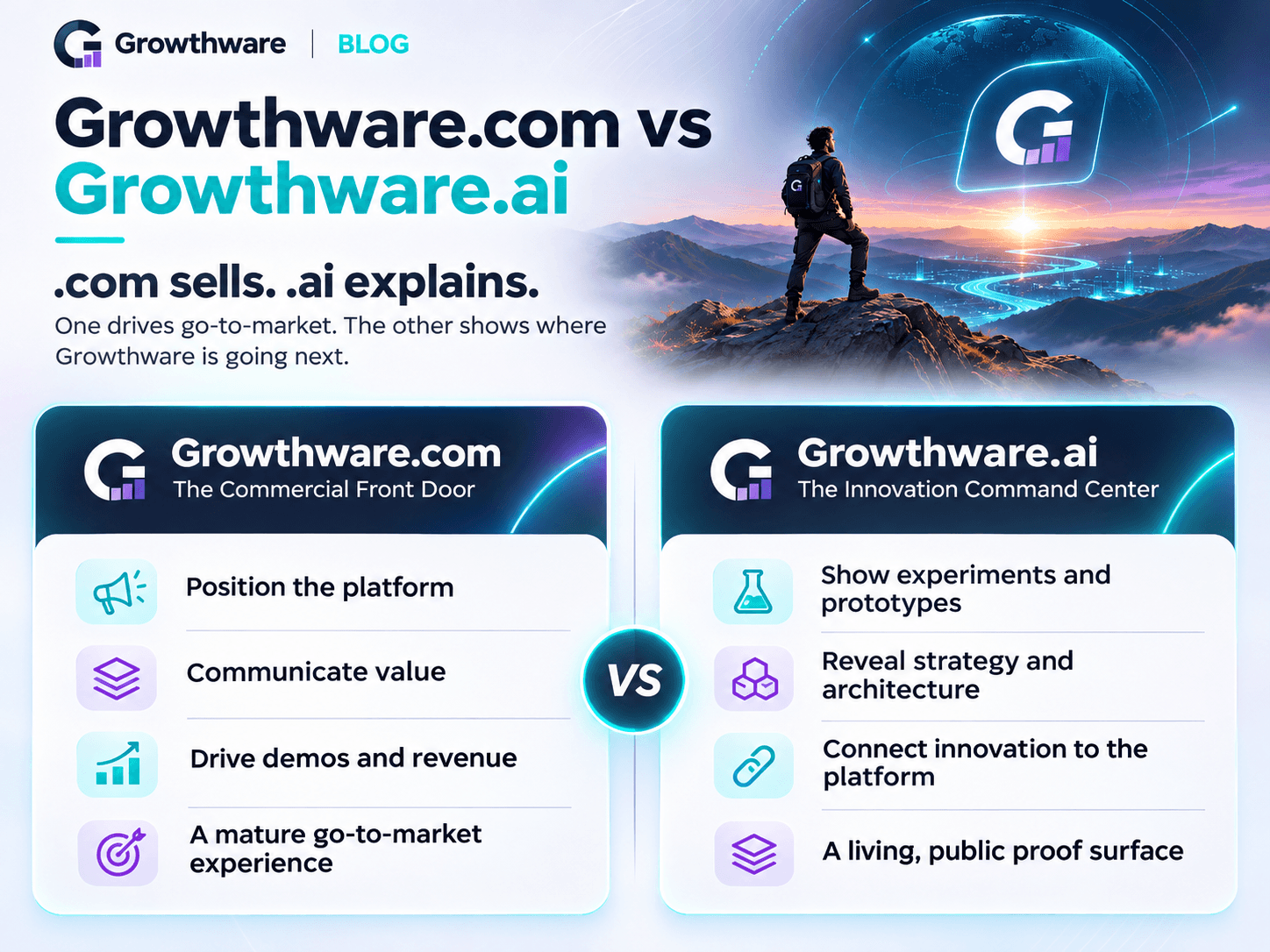
The .ai domain is where Growthware can show the system in motion. It organizes experiments. It connects prototypes. It explains architecture. It reveals how different product bets relate to one another. And it gives people a way to move from a strategic idea to actual proof.
Some of the things visible on Growthware.ai may eventually become major parts of the commercial platform. Others may remain experiments. Some may evolve. Some may disappear. That is part of the point.
Innovation is not a straight line. Growthware.ai gives us a place to explore publicly without forcing every new idea into the polished commercial story too early.
When a company experiments aggressively, one problem appears quickly: everything can start to look disconnected.
One prototype lives here. Another tool lives there. A new scoring model launches somewhere else. A research concept becomes another subdomain. Pretty soon, a company can have a lot of motion but no clear story.
Growthware.ai is designed to prevent that. The root site acts as the narrative glue.
The question is not: How many things can Growthware build?
The better question is: What is each experiment teaching us about the platform Growthware should become?
The current Growthware.ai root organizes 22 distinct lanes across public experiments, prototypes, core operating surfaces, strategy, creation, intelligence, and restricted IP.
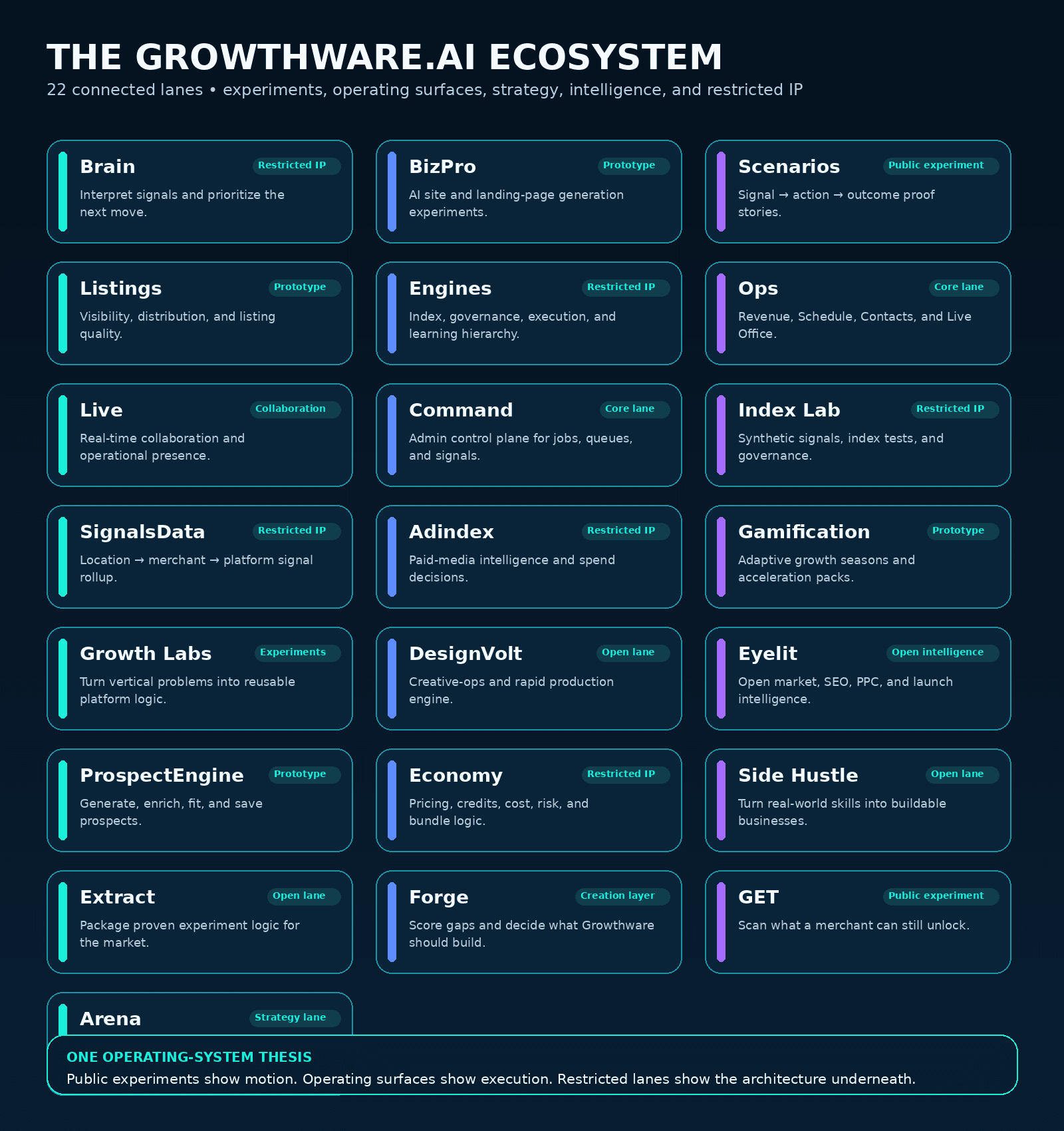
Each lane explores a different part of the Growthware thesis:
Brain — the restricted intelligence layer that interprets signals, prioritizes what matters, and recommends the next move.
BizPro — an AI-site and public page-generation prototype.
Scenarios — a public experiment that turns signal → action → outcome logic into concrete proof stories.
Listings — a visibility, distribution, and quality prototype spanning direct publishers and the Advice network.
Engines — restricted architecture showing the Growthware index and engine hierarchy.
Ops — the open core-operations lane connecting Revenue, Schedule, Contacts, and Live Office.
Live — the real-time collaboration and operational-presence lane.
Command — the admin control plane for microservices, indexes, engines, jobs, queues, and merchant signals.
Index Lab — restricted synthetic signal, index, governance, and execution experimentation.
SignalsData — restricted signal normalization from location → merchant Growth Index → platform-wide Growthware Index.
Adindex — private paid-media intelligence, optimization, and spend-decision logic.
Gamification — the GrowthOS prototype for adaptive growth seasons and acceleration packs.
Growth Labs — the live experiments engine that turns narrow vertical problems into reusable platform logic.
DesignVolt — the creative-ops engine for fast-turn graphics and campaign production.
Eyelit — the open intelligence lane for launches, SEO, PPC, market movement, concept overlap, and build estimates.
ProspectEngine — prospect generation, enrichment, fit scoring, similar-company lookup, and export.
Economy — restricted pricing, credits, cost, risk, and bundle modeling.
Side Hustle — the open skill-to-opportunity engine for business, service, and app concepts.
Extract — the market-facing handoff that packages what Labs proves.
Forge — the creation layer that identifies vertical gaps and recommends what Growthware should build next.
GET — the Growth Enablement Tool experiment for scanning what a merchant can still unlock.
Arena — the strategy lane for competitive context, category framing, and market positioning.
The point of Growthware.ai is not “look how much we built.” The point is to show how each lane tests a different piece of the same operating-system thesis.
Brain interprets. SignalsData normalizes. Indexes measure. Governance decides. Engines route action. Ops, Live, and Command make operations visible. Labs, Extract, and Forge form a discovery-to-creation loop. Arena explains market posture. GET exposes merchant opportunity. Side Hustle extends the system into new-business creation.
The lanes are the proof surfaces. The architecture is the glue.
A simple way to understand the architecture is: Indexes score. Governance decides. Execution acts. History teaches.
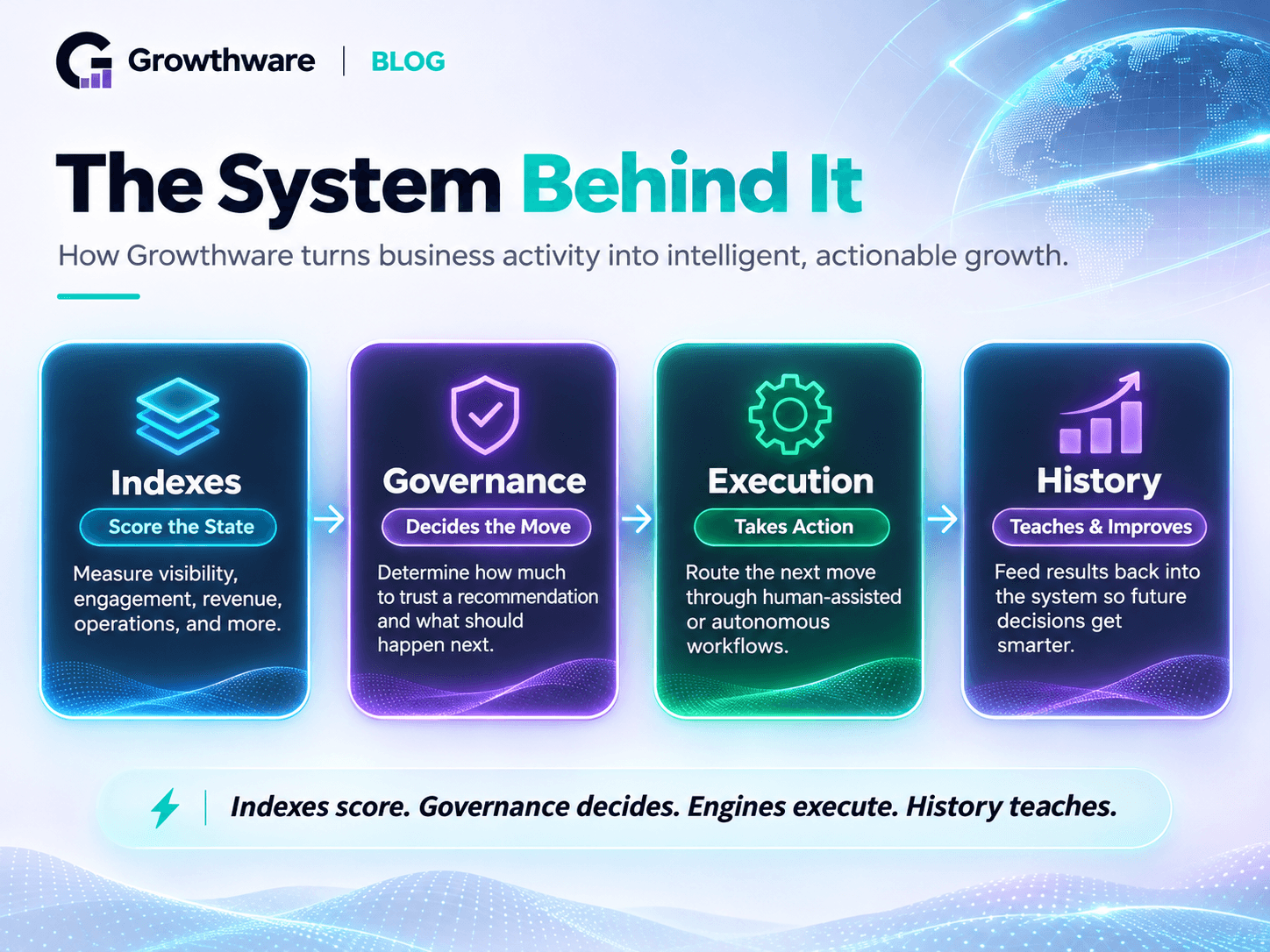
The index layer measures what is happening across the business: visibility, engagement, trust, revenue, operations, listings, website performance, reviews, competitive benchmarks, and paid-media truth. The point is not scoring for the sake of scoring. It is creating an understandable picture of business state.
Not every recommendation should be treated equally. Confidence, decay, trust thresholds, approval logic, and historical performance determine whether the next move should be suggested, reviewed, or eligible for automation.
Once an action is trusted, the next step is execution. That may mean routing a task to an operator, triggering an automation, updating a workflow, sending a reminder, or eventually letting a trusted engine execute autonomously.
The system should learn from outcomes. Did the recommendation help? Did revenue improve? Did bookings increase? Did a particular action fail repeatedly? Historical performance becomes part of future decision-making.
Growth Labs → Extract → Forge is a product-learning loop. Labs finds reusable patterns, Extract packages the first market-facing expression, and Forge identifies what deserves to be built next.
SignalsData → Indexes → Brain → Governance → Engines is the intelligence and control loop.
Ops → Live → Command → History makes execution, collaboration, control, and feedback visible.
Arena matters because Growthware.ai is not only about internal product architecture. It is also about explaining the category Growthware is trying to create and defend.
Arena is the strategy lane. It provides competitive and market context so outside audiences can understand where Growthware sits, what it is combining, and why the strategy is different.
Because strategy is more credible when there is evidence behind it. Anyone can put a futuristic roadmap into a slide deck. Growthware.ai is intended to go further.
For merchants, it shows the outcome path. For internal teams, it creates shared language. For partners and agencies, it shows scale and attach points. For investors and product-minded visitors, it demonstrates strategic coherence.
The experimentation is deliberate.
Growthware.ai is public-facing, but that does not mean every part of Growthware's intellectual property should be open. Some surfaces are fully public. Some are prototypes with modeled or synthetic data. Deeper architecture remains restricted.
The goal is to show enough real work to demonstrate depth without publishing every formula, model, or proprietary system.
It is easy to describe software by listing features: Contacts, Inbox, Calendar, Payments, Listings, Websites. But that description misses the larger opportunity.
The real question is what happens when those tools become connected.
A contact becomes a signal. A booking becomes a signal. A payment becomes a signal. A review becomes a signal. A listing problem becomes a signal.
The system begins to understand the state of the business. Indexes measure that state. Brain helps interpret it. Governance determines what can happen. Execution puts the decision back into the operating system. History helps the system improve.
Growthware.com and Growthware.ai are not competing websites. They answer different questions.
Growthware.com asks: What can Growthware do for my business?
Growthware.ai asks: What is Growthware becoming?
One is the commercial front door. The other is the innovation command center behind it.
Together, they tell a much stronger story: not just a software company adding features, but a connected operating system being built, tested, and improved in public.
See all 22 lanes, the systems map, restricted architecture, and the live experiments shaping what Growthware becomes next. Explore the Innovation Command Center →
Growthware — building the systems behind what comes next.

Article by
Justin Liles
Justin Liles builds, publishes, and writes about the systems, ideas, and stories shaping what comes next for Growthware. His work spans product strategy, AI, connected business intelligence, entrepreneurship, growth infrastructure, and the architecture behind Growthware’s evolving business operating system. He is the creator behind Growthware.ai’s innovation ecosystem, Growthware Daily, Hidden Gems, Builder’s Journal, original research, product experiments, and strategic frameworks exploring how technology, creativity, intelligence, and execution can work together to create meaningful growth.


